

Smoke Alarms

755HA5L
755LPSMA4
755PFM4
755PSMA5
755PSMA5L
755RB5
755RFB2
755WSA
756
CLP599WSA
CLP599WSAL
Everything you need to know about smoke alarms for residential buildings (Class 1a)
What type of smoke alarm do I install?
The smoke alarm must:
- comply with AS 3786:2014 standards
- contain a photoelectric sensor and not an ionising sensor (Queensland and Northern Territory only)
- be hard-wired to the mains electricity power supply (with battery backup) for homes built after (SA 1995) (TAS, WA, NSW, VIC & QLD 1997) (NT 1998)
- be interconnected to every other smoke alarm installed in the dwelling via hard wire or wireless connectivity for:
- homes built after 1st May 2014
- all rental properties in Queensland
- all owner occupied homes in Queensland starting from January 1st 2027
- at minimum, have a 10-year non-replaceable battery for:
- homes built prior to July 1997 in Queensland
- homes built prior to July 1998 in Northern Territory
- homes built prior to October 2009 in Western Australia (only where a mains smoke alarm is not able to be installed)
- homes built prior to 1995 and later purchased or leased/rented in South Australia
- homes built prior to August 1997 and later rented/leased in Victoria
- homes built prior to July 1997 and rented/leased in Tasmania
- use as additional smoke alarms above the state/territory requirement
What about the maintenance of a smoke alarm?
The smoke alarm:
- must be replaced after 10 years from date of manufacture
- must be replaced after a fire
- needs to be tested every month
- needs to be cleaned every 3 to 6 months - Use a vacuum cleaner with a soft brush to clean dust and cobwebs. Then spray insect repellent on a cloth and gently wipe around the smoke alarm to keep insects out. Do not spray inside the smoke alarm. Also, check the unit for a build-up of oils from cooking, or from insects and their by-products, as these may be blocking the sensor and can cause a false alarm.
- if the smoke alarm contains a replaceable battery backup, the battery must be replaced every 12 months.
- if the smoke alarm is 'chirping' or 'beeping', there are typically two main reasons:
- Low battery. If the alarm starts beeping once every 40 seconds, the backup battery needs replacing.
- False alarm. If your Clipsal smoke alarms are going off when there is no smoke present, firstly identify the unit which has been triggered. You can do this by looking for the smoke alarm with the flashing Red LED, while the alarms are still sounding, or by looking for one flash ever 2 seconds for up to 72 hrs. Once identified, follow the cleaning instructions above. If the problem chirp or beep remains, the smoke alarm may need replacing.
Positioning Smoke Alarms in a Residential Dwelling (Class 1a)
| Requirement | ||
| Ceiling | Flat ceiling | Minimum 300mm from the wall |
| Cathedral ceiling | 500mm to 1500mm from the peak | |
| Vaulted ceiling | 500mm to 1500mm from the peak & minimum 300mm from exposed joist | |
| Suspended ceiling (closed) | Minimum 300mm from the wall | |
| Suspended ceiling (open) | Must be mounted on the upper most ceiling & minimum 300mm from the wall | |
| Beamed (exposed joist) ceiling | Minimum 300mm from the wall & mounted on the underside of the joist | |
| Lean-to ceiling | 500mm to 1500mm from the peak | |
| Tray ceiling | Minimum 300mm from the edge of the tray section and on the highest point of the room | |
| Wall | Wall mount | 300mm to 500mm from the ceiling & minimum 300mm from the corner of 2 walls. (Only if not practicable to mount a smoke alarm on a ceiling) |
| Obstacles | Ceiling fan | Minimum 400mm (recommended minimum 1000mm) from ceiling fan blades |
| Ducted inlet/outlet | Minimum 400mm (recommended minimum 1000mm) | |
| Downlight / Pendant light | Minimum 300mm (recommended minimum 1000mm) | |
| Window | (Recommended minimum 1000mm) | |
| Internal Door | (Recommended minimum 300mm) | |
| External Door | (Recommended minimum 1000mm) | |
| Wall mounted air conditioning unit | (Recommended minimum 1000mm) | |
| Stairwell | Install a smoke alarm in the stairway between each level | |
| Other obstacles that will cause dead air space | Minimum 300mm (recommended minimum 1000mm) | |
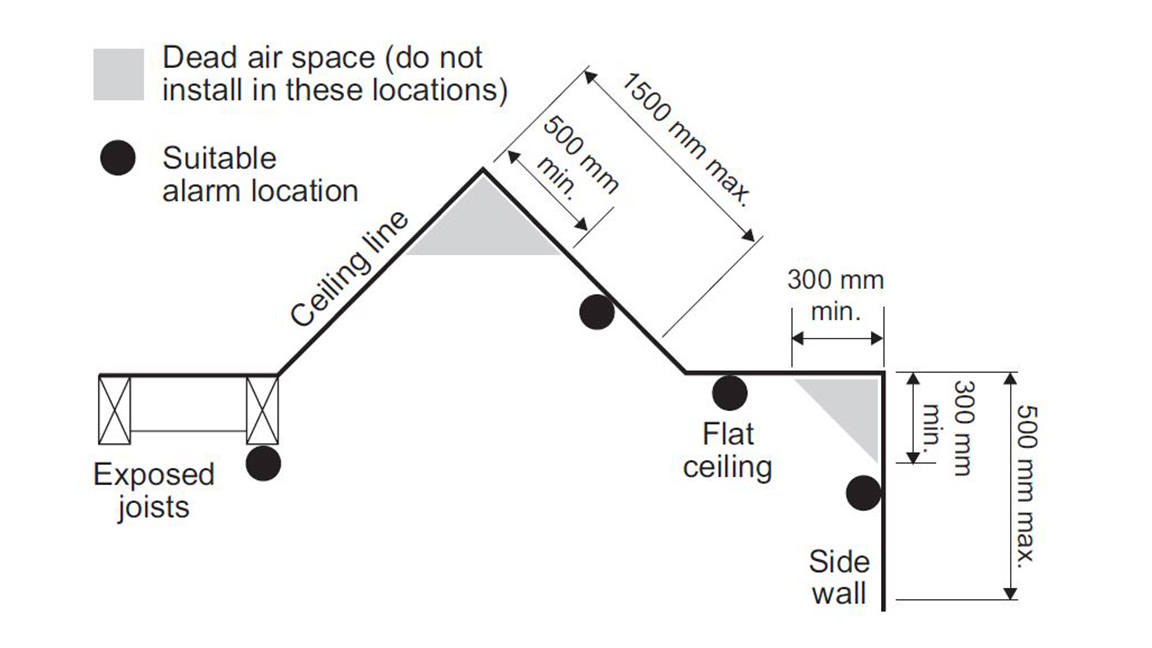
Where to install a smoke alarm in a Residential Dwelling (Class 1a)
| Minimum requirements | ||
| Australia | Queensland | Every bedroom and hallway of every floor |
| New South Wales Australian Capital Territory Victoria Tasmania South Australia Western Australia Northern Territory |
| |
Disclaimer: This is a general recommendation taking into consideration the national construction code and all specific state/territory rules. Before installing a smoke alarm in your state/territory, the installer must understand the rules for their state/territory and the type of dwelling that applies. All state/territory links are provided below. If any link no longer works, please let us know and ask your local fire department for the new link or locate the rules by contacting your state/territory government department. The information provided on this page was true on September 1st 2025.
State and Territory smoke alarm laws/references:
Queensland
New South Wales
Australian Capital Territory
Victoria
Tasmania (see National Construction Code above)
South Australia
Western Australia
Northern Territory