
Datasheet
Specifications
Design
Range
Product brand
Physical
Mercury free
Rohs exemption information
Environmental disclosure
Eu rohs directive
Reach regulation
China rohs regulation
Others
Legacy weee scope
Package 1 bare product quantity
Average percentage of recycled plastic content
Weee label
Weee applicability
Unit type of package 1
Number of units in package 1
Package 1 height
Package 1 width
Package 1 length
Package 1 weight
Total lifecycle carbon footprint
Carbon footprint of the manufacturing phase [a1 to a3]
Carbon footprint of the manufacturing phase [a1 to a3]
Carbon footprint of the distribution phase [a4]
Carbon footprint of the distribution phase [a4]
Carbon footprint of the installation phase [a5]
Carbon footprint of the installation phase [a5]
Carbon footprint of the use phase [b2, b3, b4, b6]
Carbon footprint of the use phase [b2, b3, b4, b6]
Sustainable packaging
Carbon footprint of the end-of-life phase [c1 to c4]
Carbon footprint of the end-of-life phase [c1 to c4]
Pvc free
Halogen-free status
Silicone-free
Take-back
Product contributes to saved and avoided emissions
Removable battery
Total lifecycle carbon footprint
Average percentage of recycled metal content
Packaging made with recycled cardboard
Packaging without single use plastic
Halogen-free status
Pvc free
Silicone-free
End of life manual availability
Take-back
Warranty (in months)
Documents & downloads
hide show-
All
-
Product Brochures
-
Technical Data Catalogues
-
End of Life Manual
-
Environmental Disclosure
-
Installation Instruction
-
Certificates (MSDS)
-
Declaration of Conformity (Sustainability)

Frequently Asked Questions
I am installing a 2-wire Dimmer, when should I be using a 31CAP or 31LCDA?
Hide ShowThe 31CAP and 31LCDA both have separate uses to resolve issues experienced with 2-wire Dimmers.
The 31CAP should be used when minimum load of the device is not being met, this is usually indicated by the load/light, that is controlled by the dimmer, by glowing when it should be off. Adding the 31CAP will increase the load and prevent the load/light from glowing in the off state. Depending on how far off minimum load you are more than one 31CAP may be required.
The 31LCDA should be used in instances where the load/light is flickering constantly, which indicates an issue with compatibility with the 2-wire dimmer used. The 31LCDA resolves these incompatibilities and flickering should then stop, if the flickering is reduced but still present you may need another 31LCDA to completely resolve. No more than 3x 31LCDA’s should be used on one dimmer.
What is the difference between the 31Cap and 31LCDA?
Hide Show31CAP - Increases minimum load.

For further information please visit http://www.clipsal.com/Trade/Products/ProductDetail?catno=31CAP
31LCDA - Assists with compatibility issues.
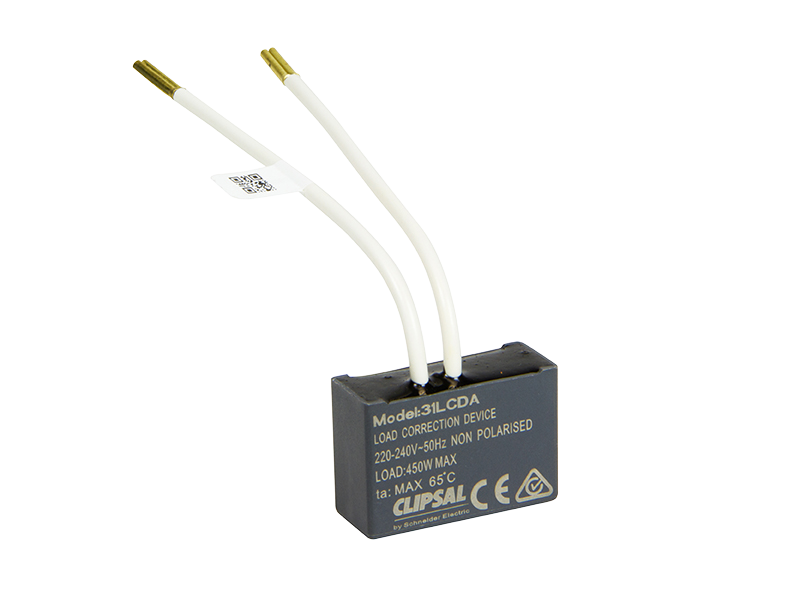
For further information please visit http://www.clipsal.com/Trade/Products/ProductDetail?catno=31LCDA
What type of LED's can be used on C-Bus Dimmers?
Hide ShowThe general recommendations for LED compatibility with C-Bus Dimmers is as follows
1) Ensure your LED's have a dedicated LED Driver (electronic transformer) that supports your C-Bus Dimmer type
2) Bench test that the LED Driver is of good quality and works as expected at your site
3) C-Bus Dimmer channels require >25W of load if less is connected to a specific channel that channel will require the addition of a 31LCDA (Load Corrective Device)
Note:
C-Bus Leading Edge Dimmers will require LED's which have electronic transformers (LED Driver) which support Leading Edge AC phase control dimming (as noted in the compatible loads section of the installation manual)
C-Bus Universal Dimmers will require LED's which have electronic transformers (LED Driver) which supports Trailing Edge AC phase control dimming (as noted in the compatible loads section of the installation manual).
Although Universal Dimmers can support leading OR trailing edge AC phase control dimming it needs to be exclusively one or the other (NOT BOTH). As such LED Drivers which note LE/TE LED Driver are NOT suitable for the Universal Dimmer.